
Architecture & Design · Design Insight
Recent hospitality projects show how metal can make a hotel recognisable before a guest reaches the room, carrying a sense of place through facades, dividers and carefully chosen touchpoints.

Hotel identity is often discussed through colour, graphics and service. These projects suggest another route: let material carry part of the memory. A bronze facade can frame the first encounter. A decorative divider can make a suite feel private without closing it off. A liquid metal finish can update a familiar detail while keeping the room connected to craft.
These are not interchangeable uses of metal. AvroKO uses bronze to give Canopy Bangkok Sukhumvit a clear arrival image. JOI-Design places delicate metal and ornamental dividers inside the cross-cultural narrative of Taj Hessischer Hof in Frankfurt. Cheng Chung Design uses liquid metal at The St. Regis on the Bund in Shanghai as a softer contemporary reading of bronze. Together, they show a shift from metal as a generic luxury signal to metal as a specific piece of the story.
01 / Arrival as brand memory
A bronze facade can make the first few seconds do more work
Canopy Bangkok Sukhumvit · Bangkok · AvroKO · Published August 12, 2026
Canopy Bangkok Sukhumvit is the first Southeast Asian hotel for the Canopy brand. Sleeper describes a 174-room property whose public spaces draw on Asoke’s industrial history, the glamour of the nearby Sri Krung Sound Film Studio and the neighbourhood’s contrast between old and new. The bronze facade is inspired by vintage film cameras.
That reference matters because it gives the metal a reason to exist. The facade is not presented as a neutral premium finish; it becomes part of the hotel’s local reading, linking the arrival to a specific cultural and industrial memory. Inside, warm neutral materials, curved forms and the blue Paa Khram fabric canopy continue the residential side of the concept, keeping the bronze gesture from becoming a single-note statement.
For architects and developers, the useful move is to treat the entrance metalwork as a piece of identity infrastructure. Its colour, scale, reflectivity and relationship to the street can establish the project before signage does. A custom bronze stainless steel decorative screen can serve a similar role where the brief needs a memorable threshold, provided the pattern and lighting are developed with the architecture rather than added afterward.


02 / Ornament with a job to do
Decorative dividers can carry culture without closing the room
Taj Hessischer Hof · Frankfurt · JOI-Design · Published August 10, 2026
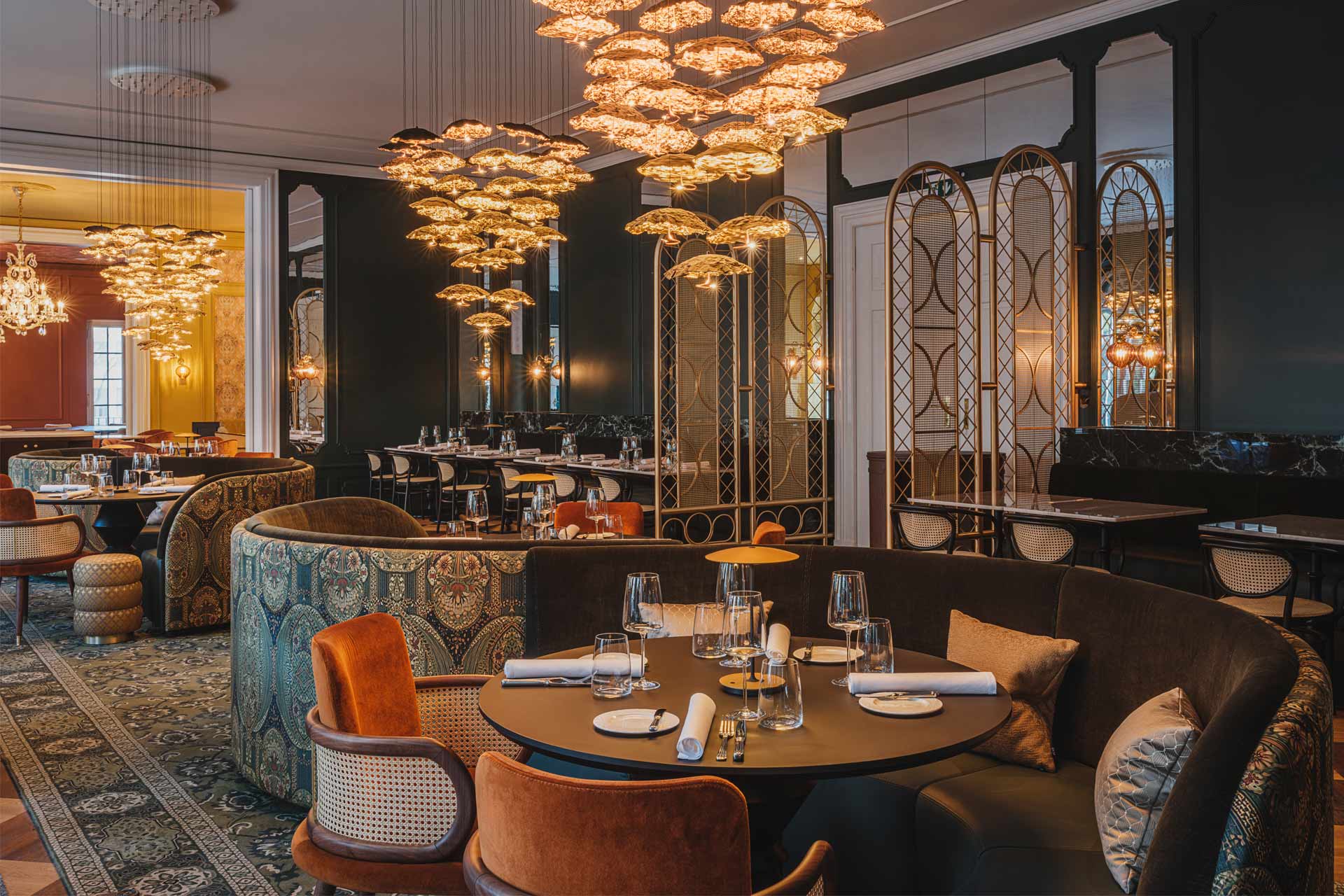
At Taj Hessischer Hof, JOI-Design works within an existing hotel structure assembled across the 1950s and 1970s. The project’s design language brings Indian references into dialogue with classical European proportions, using jewel tones, patterned fabrics, bespoke furniture and decorative detailing across 117 guestrooms and nine suites.
Metal appears as a quiet mediator in that conversation. Delicate metal and ornamental room dividers add separation without undermining the open character of the rooms. In the restaurant, gilded accents and golden fretwork panels sharpen the warmer palette, while chandeliers, marble and dark timber keep the metal from reading as a standalone surface. The result is not a themed interior; it is a sequence of layers in which metal helps the eye move between colour, pattern and light.
This is a useful reference for luxury hospitality, sales centres and high-end residential common areas. A screen can be decorative, but it still needs a spatial purpose: guiding circulation, filtering a view, framing a dining zone or giving a lounge a sense of address. A custom gold stainless steel laser-cut screen partition is relevant when the design calls for that combination of visual permeability and a controlled, repeatable pattern.

03 / A contemporary reading of craft
Liquid metal makes familiar luxury feel less literal
The St. Regis on the Bund · Shanghai · Cheng Chung Design · Published August 7, 2026
For the suite renovation at The St. Regis on the Bund, Cheng Chung Design combines finely crafted timber, marble and advanced fabrication. Sleeper’s account is specific about one decision: liquid metal finishes replace conventional bronze detailing with a softer, almost tactile luminosity.
The significance is less about a new colour than a new surface behaviour. Traditional bronze can signal permanence and ceremony. A liquid metal finish can keep that association while reducing the visual weight of the detail. In a suite, where the design must feel composed at close range, this softer reading allows the metal to sit beside timber and stone rather than compete with them.


What architects can learn
Specify the story, then specify the surface
Give the entrance a reason
Metal at the threshold should reinforce the project’s architectural or cultural idea, not function as a generic luxury cue.
Use dividers to organise experience
Pattern, density and transparency should respond to privacy, circulation and the distance from which the screen is seen.
Let warm materials do part of the work
Timber, marble, stone and textiles can make a reflective or gilded surface feel more settled and less decorative.
Test finish under real light
Daylight, concealed LEDs and warm hospitality lighting will change how bronze, gold and liquid metal are perceived.
Design for close viewing
Luxury details are often judged at the hand and eye: returns, edges, joints and surface consistency matter as much as the large image.
Separate identity from repetition
A small number of memorable metal moments can give a project character without turning every plane into a branded surface.
Conclusion
Canopy Bangkok, Taj Hessischer Hof and The St. Regis on the Bund approach metal from different directions, but all three make the material carry more than surface value. Bronze establishes a public identity, decorative dividers create a layered cultural interior, and liquid metal gives familiar luxury a softer contemporary register. For designers and project teams, the opportunity is to use metal with the same specificity as any other architectural language.
At Xinmao Metal, we follow global architecture and interior design trends to understand how custom stainless steel and architectural metalwork can support increasingly ambitious commercial and hospitality spaces.
Project References
Canopy Bangkok Sukhumvit · Sleeper · Published August 12, 2026 · AvroKO
Taj Hessischer Hof · Sleeper · Published August 10, 2026 · JOI-Design
The St. Regis on the Bund · Sleeper · Published August 7, 2026 · Cheng Chung Design