
Metal Industry · Procurement & Logistics
Finished panels can leave the factory within tolerance and still arrive unusable when their face, edges, identity or handling route are unprotected. Export packaging is part of the metalwork specification, not a line added after fabrication.
The package must preserve the panel from factory release to site. This guide turns “seaworthy packing” into controls for finished stainless panels, screens and trims.

Define the failure before choosing the crate
The first packing question is not “wooden case or pallet?” It is which failure the package must prevent. A mirror, PVD, hairline or etched face can be marked by a strap, dirty separator, wet wrap or rough lifting point. A formed return can be bent while the main face remains clean, while a heavy crate may be impossible to unload with the site’s lift or forklift.
The Tsingshan export packing guide separates moisture, salt exposure, edge impact, load movement, identification and film aging as different risks. Use the same separation in the purchase order. Define the visible side, finish direction, edge sensitivity, maximum package weight, lifting points, destination and receiving equipment before the supplier finalises the pack.
Four records should agree:
- The approved panel schedule and elevation.
- The packing list and package numbers.
- The crate or pallet marks and handling instructions.
- The loading photographs and seal record.
If the records use different part names, the site team may not locate a protected panel or confirm its installation sequence.
Match the packing method to the finished metal
Different architectural metal forms need different protection. A flat sheet, folded cassette, laser-cut screen and long trim should not share an undefined “standard export pack.”
| Finished metal | Main transit risk | Controls to define |
|---|---|---|
| Flat or large-format panels | Face scratches, bowed bundles and strap marks | Clean separator, approved film, rigid skid, edge/corner guards, strap isolation and bundle limit |
| Folded or cassette panels | Crushed returns, corner impact and hidden frame movement | Foam at returns, shaped blocking, face separation, clearance and lifting orientation |
| Screens, frames and openwork | Protrusions catching, twist and pattern damage | Braced frame, protected corners, approved nesting, accessory box and orientation marks |
| Trims, profiles and long sections | Bending, end damage and lost identity | Continuous support, end caps, bundle marks, lifting points and unloading sequence |
The Jinling packaging reference separates sheet/plate support, face protection, edge guards, waterproof wrapping and labels. Use it as a procurement model, not universal.
Protect the visible finish as its own requirement
Protective film is part of a finish-control plan. Confirm which side receives it, when it is applied, how long it may remain and how the receiving team should remove it. Heat, sunlight or long storage can leave residue or make removal difficult, so follow the approved finish and supplier’s storage instructions.
Use clean, compatible interleaving between polished or decorated faces. Keep carbon-steel tools, dirty slings, abrasive wood splinters and salt-contaminated dunnage away from the visible stainless surface. Add pads below straps and isolate corners so the restraint system cannot print through the film. For a directional brushed finish, mark grain direction on the package and on the panel ID, not only on the drawing.
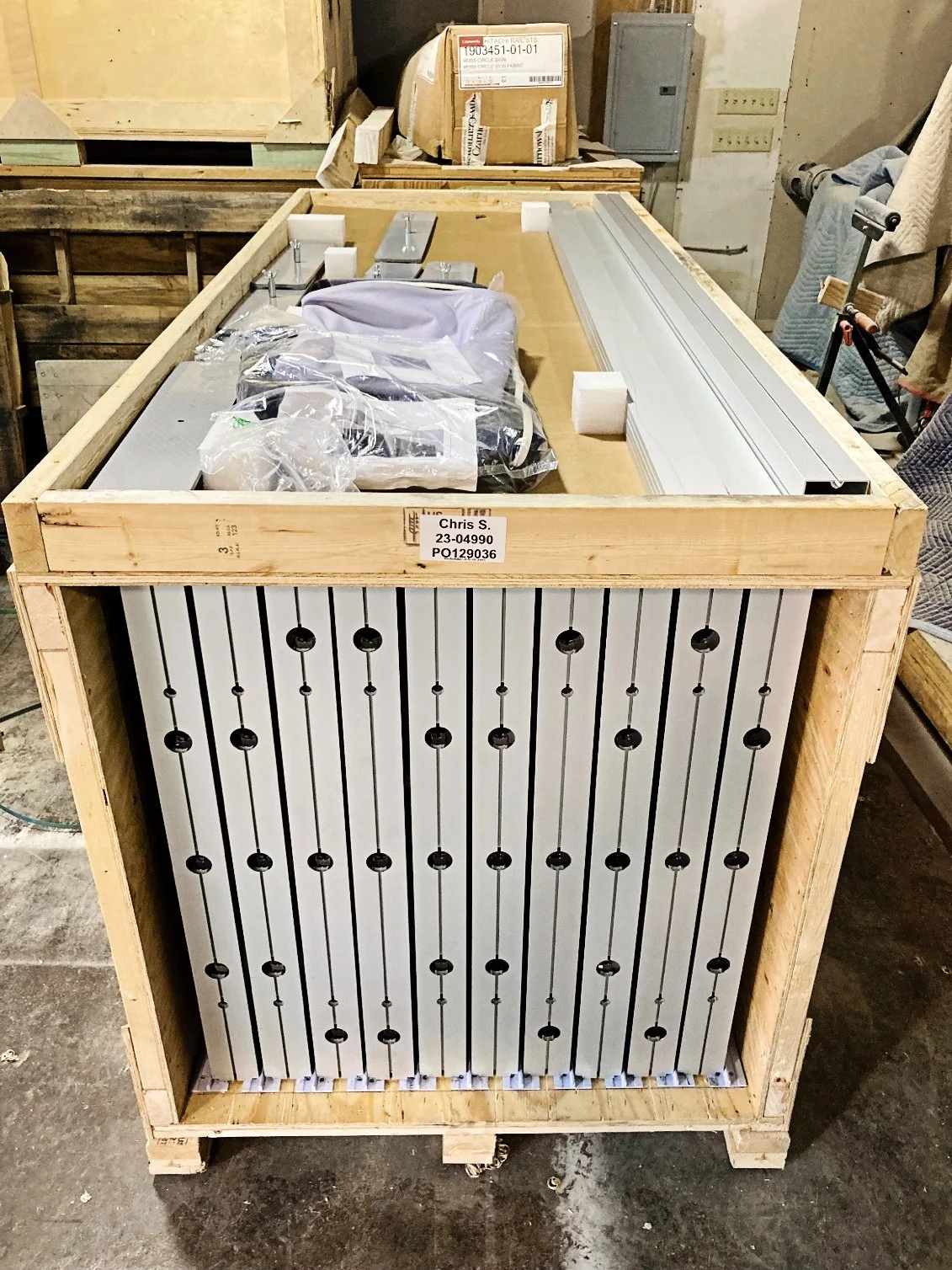
Treat surface protection, edge protection and load restraint as three separate checks with three sign-offs.
Build the crate around the handling route
The crate has to fit the journey and the site. Record package dimensions, gross weight, centre of gravity, forklift pockets, crane points, opening direction and unloading side. Large wall panels may need a rigid frame or cradle; trims may need a labelled accessory case; a screen may need bracing that keeps its pattern off the crate wall.
Do not place a strap across a finished face for convenience. Show the strap path, separator and corner block on the packing drawing. Keep hardware, trims, touch-up material and installation notes in a marked compartment, and mark the lot and installation zone on every package for phased delivery.
The Xinmao Metal shipping policy says packaging is determined by product type, dimensions, finish and agreed shipping method, with special crates or project-specific packing confirmed separately. That is the right level of specificity: the quotation should identify the agreed protection and any additional packing or fumigation requirement instead of relying on a generic “export packing” phrase.
Keep panel identity alive through transit
Panel identification is a quality-control tool. Use a panel ID from elevation through shop drawing, inspection record, packing list, crate mark and installation map. If a panel is rotated, split into submodules or packed with a matching trim, show that relationship on the mark.
Label every package with:
- Which building zone and elevation does it serve?
- Which panel IDs and quantity are inside?
- Which face or grain direction must remain visible?
- What is the gross weight and safe lifting orientation?
- Which crate or accessory pack must arrive with it?
Before container closing, photograph the clean floor, package ID, protection, blocking, bracing, restraint, seal and final position. The record speeds review.
Treat moisture and wood packaging as separate checks
Moisture control is more than wrapping a bundle in plastic. Put the clean, dry container, barrier layer, drainage or desiccant strategy and storage period in the packing note. Wrapping warm or wet material can trap condensation, so give the receiver instructions for opening, ventilation and film removal.
Wood packaging also has a separate phytosanitary question. The International Plant Protection Convention’s adopted ISPM standards and ISPM 15 text address raw-wood packaging and dunnage used in international trade. Confirm the destination-country implementation, the exact wood components used, the required mark and whether plywood or another processed product falls within the destination rule. A compliant wood mark does not prove that a mirror face is protected, and a clean metal package does not prove that its dunnage is compliant.

Make receiving inspection part of the shipment
The receiving plan should tell the site team what to inspect before installation or disposal of the original packaging. Check the package number, seal, crate damage, wet marks, crushed corners, strap marks, film condition and visible face. Photograph outside and inside before moving panels, and record damage against the package ID and freight document.
Do not ask the installer to remove every film layer immediately. Keep the approved protection in place while nearby wet trades, stone work and ceiling work continue, but follow the film manufacturer’s storage and removal limits. If a panel is opened for measurement or fitting, record its condition and reseal it with an agreed material.


Turn the packing decision into an RFQ field list
Give the supplier more than a surface name so the quote connects packing to the metalwork. Include:
- elevations, sections and panel schedule;
- material and finish reference, including visible face and grain direction;
- module dimensions, formed returns, protrusions and fragile edges;
- quantity, package limits, destination country, port and site access;
- lifting equipment, unloading direction and phased delivery sequence;
- required film, separators, edge guards, crate or frame type and package marks;
- Incoterms, freight responsibility, insurance and export documents;
- photographs required before loading and the receiving-damage process.
Start from the relevant stainless steel wall-panel collection, then attach the elevations, panel schedule and package limits. Xinmao’s advanced shop-drawing and value-engineering service can keep panel IDs, finish direction and packing marks aligned. Its end-to-end fabrication service describes secure packaging and logistics as part of a project route, while the Shenzhen 50-storey office-building metal honeycomb cladding case illustrates why multi-zone deliveries need a package map. Use the contact page to confirm the project information, final packing method and any special documents in the quotation or pro forma invoice; do not infer a universal crate, film or delivery promise from a product photograph.
Pre-dispatch checks
- Is the visible face, finish direction and film requirement written on the packing note?
- Does every panel ID match the elevation, packing list, crate mark and installation sequence?
- Are edges, returns, corners, protrusions and accessory packs protected separately?
- Are gross weight, centre of gravity, lifting points and unloading limits visible?
- Are container condition, moisture controls, blocking, bracing and seal photos required?
- Has the destination-country wood-packaging rule been checked for the actual crate and dunnage?
- Does the receiving team know what to photograph before opening or discarding packaging?
What does “seaworthy packing” mean for stainless steel panels?
It should describe the finish protection, separators, edge and corner protection, restraint, lifting method, moisture plan, package identification and receiving evidence for the actual panel package and route. The phrase alone is incomplete.
Should protective film stay on during shipment?
Often it can, when the film, storage condition and removal timing are agreed with the supplier and finish manufacturer. Film type and duration are finish-specific; confirm the limit before dispatch.
Does ISPM 15 certify the metal package?
No. ISPM 15 concerns the phytosanitary treatment and marking of covered raw-wood packaging and dunnage. It does not certify the crate’s structural design, surface protection, cargo restraint or the finished stainless steel itself.
Scope note: This article is a procurement and handling guide. Final crate design, cargo securing, lifting, storage, phytosanitary, customs, freight, insurance and project acceptance decisions remain with the appointed logistics providers and destination authorities.