
Metal industry insights · Fabrication, surface protection and handover
A visible stainless steel panel is only as reliable as the heat-affected area, tools, handling and post-weld treatment behind its finish.
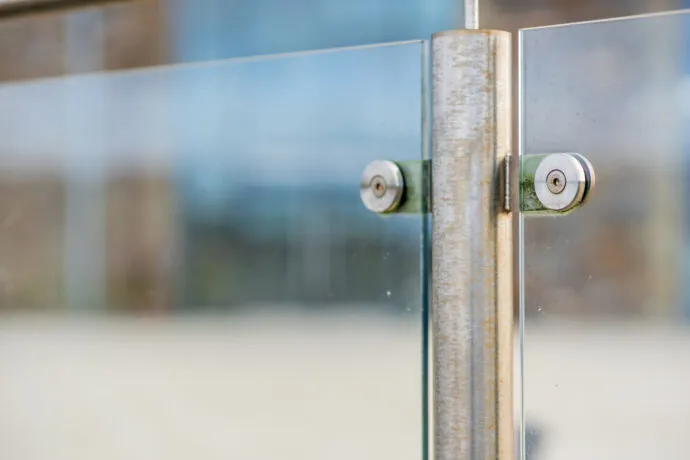
A stainless steel panel can leave the shop with an attractive finish and still carry a weak point at every weld, cut edge or tool mark. Months later, the issue may appear as brown staining, a rough halo or a persistent streak below a joint. Handle these symptoms as specification issues: control heat tint, free iron, surface roughness, water paths and handover evidence.
01Why clean metal is part of the specification
Stainless steel depends on a thin passive film at the surface. Chromium in the alloy reacts with oxygen and helps form that protective layer. The film can renew itself when the surface is clean and exposed to oxygen, but fabrication and installation can disturb the conditions that allow it to work well.
The February 2026 worldstainless corrosion session links tea staining to grade selection, fabrication or jointing, surface finish and cleaning. An appearance defect may begin at a weld or fastener zone and then be blamed on the base material, so the surface-making and treatment route should be recorded.
Tea staining is mainly an appearance issue, but deposits, crevices and contamination can become more aggressive in chloride-bearing environments. Clean, well-drained metal belongs in durability planning.
02What changes after welding
Welding can leave heat tint and oxide scale around the joint. The heat-affected surface may also contain a chromium-depleted layer, roughness or small defects that hold deposits. Tools, brushes, cutting discs and grinding dust can add free iron that later rusts on the surface, even when the grade was correctly selected.
INOX-COLOR’s June 2026 technical note separates the treatment decisions clearly. If visible heat tint or scale remains, pickling followed by passivation is generally the appropriate route. If the surface has already been mechanically processed and is free of scale, passivation alone may be sufficient. If extraneous rust or early corrosion is present, the contamination must be removed before the passive surface is restored.
Pickling and passivation are not interchangeable labels. Pickling removes a controlled, thin layer containing oxide or contamination; passivation supports restoration of the protective surface condition. The sequence depends on the component, finish and exposure. “Clean stainless steel after welding” leaves too much to interpretation.

Treatment choice
The treatment must suit the component. Sheets and profiles may be handled differently from large welded assemblies or closed pipework. The finish that the architect approved also has to survive the treatment.
Image source: Outokumpu - Stainless steel and atmospheric corrosion: what you need to know.
03Choose the process for the component and the finish
Component geometry affects access, rinsing and residue removal. INOX-COLOR describes immersion pickling for sheets and profiles, spray pickling for bulky components, and circulating treatment for closed systems. Decide the route before a welded assembly becomes difficult to reach.
Finish approval needs the same care. Mechanical removal should match the surrounding grain without leaving a rougher patch. ASSDA warns that abrasive work, rough surfaces and horizontal areas collect contaminants, and that pickling can dull a bright finish. Sample a polished, coloured, embossed or satin surface after the proposed weld-cleanup sequence.
For exterior panels, orientation and drainage matter as much as the treatment name. Nickel Institute guidance recommends reducing horizontal dirt traps, allowing uniform rain washing and avoiding concentrated runoff. IMOA’s drainage guidance adds that grade should be reviewed alongside fluid, coastal exposure and de-icing salts. Review the panel face, joint and support as one water path.


04Where architectural details tend to fail
Visible facade cassettes are not the only concern. Decorative screens, soffits, ceiling panels, partitions and trim can contain welds or cut edges that are hard to inspect after installation. A concealed joint can still affect the exposed face through distortion or a crevice behind a fixing.
Exterior applications have the added problem of uneven wetting. A rain shadow below a coping, a folded return that holds water or a sealant edge that traps dust can stay dirty longer than the surrounding panel. ASSDA recommends free-draining surfaces, good exposure to rain washing and even drainage. It also warns against hydrochloric acid for cement or mortar residue, because it can stain stainless steel and start more serious corrosion.
Interior applications need a different maintenance assumption. A ceiling may collect construction dust before handover, while panels near pools, kitchens or wet service areas may see chlorides or cleaning chemicals without natural rain washing. The schedule should state who cleans the surface, with what products and at what stage.
05Specification/Fabrication Considerations
The following information gives the fabricator and installer a workable acceptance target. It does not replace the project’s applicable welding, chemical-treatment or facade standards. The final requirement should be reviewed against the selected grade, finish, exposure and local regulations.
| Item | Write into the package | Evidence at review or handover |
|---|---|---|
| Weld appearance | Identify visible faces, allowable projection, edge condition and whether the weld must be blended into the approved finish. | Fabricated sample inspected after final treatment, not only raw-weld photographs. |
| Heat tint and scale | Name the removal sequence and the finish that must remain after treatment. | Visual check for tint, residues and uneven patches; treatment record. |
| Free iron | Keep carbon-steel tools, brushes and abrasives away from the stainless work area. | Tooling and handling plan; free-iron test where the project risk requires it. |
| Geometry | Avoid water traps, tight crevices and uninspectable pockets at returns, fixings and folded edges. | Shop drawing review showing drainage, access and cleaning routes. |
| Finish continuity | Define grain direction, gloss, texture and the permitted visual transition at a repaired area. | Approved control sample compared with the completed panel under agreed lighting. |
| Site protection | Protect the surface during transport, adjacent cutting and masonry work; remove films before they become difficult to clean. | Installation inspection and closeout photographs before final cleaning. |
| Maintenance | State the first clean, routine wash method and restrictions on chlorides, bleach, abrasives and acids. | Handover document linked to the actual grade and finish. |
06Architects and Contractors Should Consider
For difficult environments, grade selection still comes first. ASSDA identifies 316 or equivalent corrosion resistance as a minimum reference for many marine situations, while splash, unwashed or rough-surface locations may require a higher-alloy grade. This is not an automatic 304-or-316 rule; exposure, finish, detail and maintenance still decide the package.
07Make the finish auditable before it leaves the shop
Xinmao Metal’s perspective is practical: a finish approval should stay attached to the fabricated part, the weld-cleanup route and the installation controls. A screen or ceiling panel is not fully specified when its colour or texture has been selected but the post-weld treatment, edge condition and cleaning limits remain open.
For a project using bronze stainless steel mesh partition screens, custom gold stainless steel laser-cut screen partitions or bronze water-ripple stainless steel feature ceilings, the useful coordination question is where the visible face can be inspected, cleaned and protected at each stage. That is an engineering question as much as a visual one.
The result is a clearer package: the approved surface has a defined fabrication route, the post-weld condition has evidence, and the site team knows what must not touch the metal.
08Conclusion
Architectural stainless steel does not finish when welding stops. Heat tint, free iron, roughness, trapped water and site dust can change the way a carefully selected surface performs. A sound specification names the grade and finish, defines the weld-cleanup and passivation route, protects the work during installation and records how the result was checked.
09Technical references
- INOX-COLOR, “Pickling and passivation: choose the method & prove it,” 23 June 2026.
- worldstainless, “Understanding Corrosion - Chapter 4: Tea staining,” 17 February 2026.
- Australian Stainless Steel Development Association, “Tea Staining,” accessed 19 August 2026.
- Outokumpu, “Guide for Architects: How to design stunning durable façades with stainless steel,” accessed 19 August 2026.
- Nickel Institute, “Stainless Steel in Architecture, Building and Construction: Guidelines for Maintenance and Cleaning,” accessed 19 August 2026.
- International Molybdenum Association, “Drainage,” accessed 19 August 2026.
- Metal Architecture, May 2026 issue, “Rainscreens and Building Science,” accessed 19 August 2026.