
Metal industry insights · Carbon data and material specification
EPD data is useful only when the declared product still matches the grade, finish, fabrication and assembly that the project will buy.
Architects and procurement teams are being asked to document embodied carbon earlier in the design process. That changes the way stainless steel facade, cladding and interior metal packages are discussed. A product-specific Environmental Product Declaration can make the carbon conversation more precise, but it cannot replace the metal specification. The document may describe a coil, sheet or surface product while the project purchases cut, formed, finished and installed panels. The useful work sits between those two descriptions.
01Why carbon data now belongs in the metal brief
LEED v5 places more attention on decarbonisation and embodied carbon. USGBC’s February 2026 BD+C addenda include a prerequisite for quantifying and assessing embodied carbon. The practical result is not one universal number for every stainless steel panel, but traceable evidence for the material choice the project actually makes.
Metal Architecture’s February 2026 discussion reaches a similar conclusion: request and compare EPDs, use whole-building life-cycle assessment early, and consider future reuse. Those recommendations need to become drawing, schedule and purchase-order requirements. A carbon target without a matching material description is difficult to verify later.
02What an EPD can tell you, and what it cannot
An EPD is a Type III environmental declaration based on life-cycle assessment and product category rules. It is not a performance certificate for corrosion, fire, structure or finish durability. EPD International’s current construction-product rules allow different system boundaries, including cradle-to-gate reporting and declarations with additional life-cycle modules. The boundary and declared unit must therefore be read before a comparison is made.
| EPD item | Question for the design team | Purchase-order implication |
|---|---|---|
| Declaration holder and product name | Is this the manufacturer and product family being proposed? | Record the exact grade, product code or surface family. |
| Declared or functional unit | Are the options compared per kilogram, square metre or another function? | Use the same basis when converting the project quantity. |
| Life-cycle modules | Does the document stop at the factory gate or include transport, installation and end of life? | Identify the missing stages in the project LCA or carbon worksheet. |
| PCR, operator and verifier | Were the documents prepared under comparable rules and independently checked? | Save the document number, version and validity date. |
| Geography and production site | Does the data represent the proposed source and energy mix? | Do not use a regional average as if it were batch-specific proof. |
This is why a lower GWP value is not automatically the better architectural choice. If one document covers a finished surface and another covers an unprocessed stainless steel input, the numbers are not describing the same thing. The comparison needs a common function, a common boundary and a realistic quantity.

03Move from stainless steel input to finished panel
Architectural metal is bought as a package, not as an abstract tonne of material. A facade panel may begin as sheet and then pass through cutting, forming, surface treatment, welding, packing and installation. The EPD may cover only some of those stages, so the specification should show the gap rather than imply that the sheet declaration represents the assembly.
For a cladding schedule, list the required grade, thickness, finish, panel module, joint logic and support condition. The carbon record should then identify what is included and what must be added separately, such as fabrication, off-cuts, packaging, subframes, transport and installation.
04Lower carbon does not remove the exposure review
Material selection still starts with the building’s exposure. The 2 June 2026 worldstainless structural-stainless webinar links life-cycle thinking to corrosion environment, maintenance and long-term disruption. That is the right order for an architectural package: first establish what the component must withstand, then compare lower-impact options that can deliver that requirement.
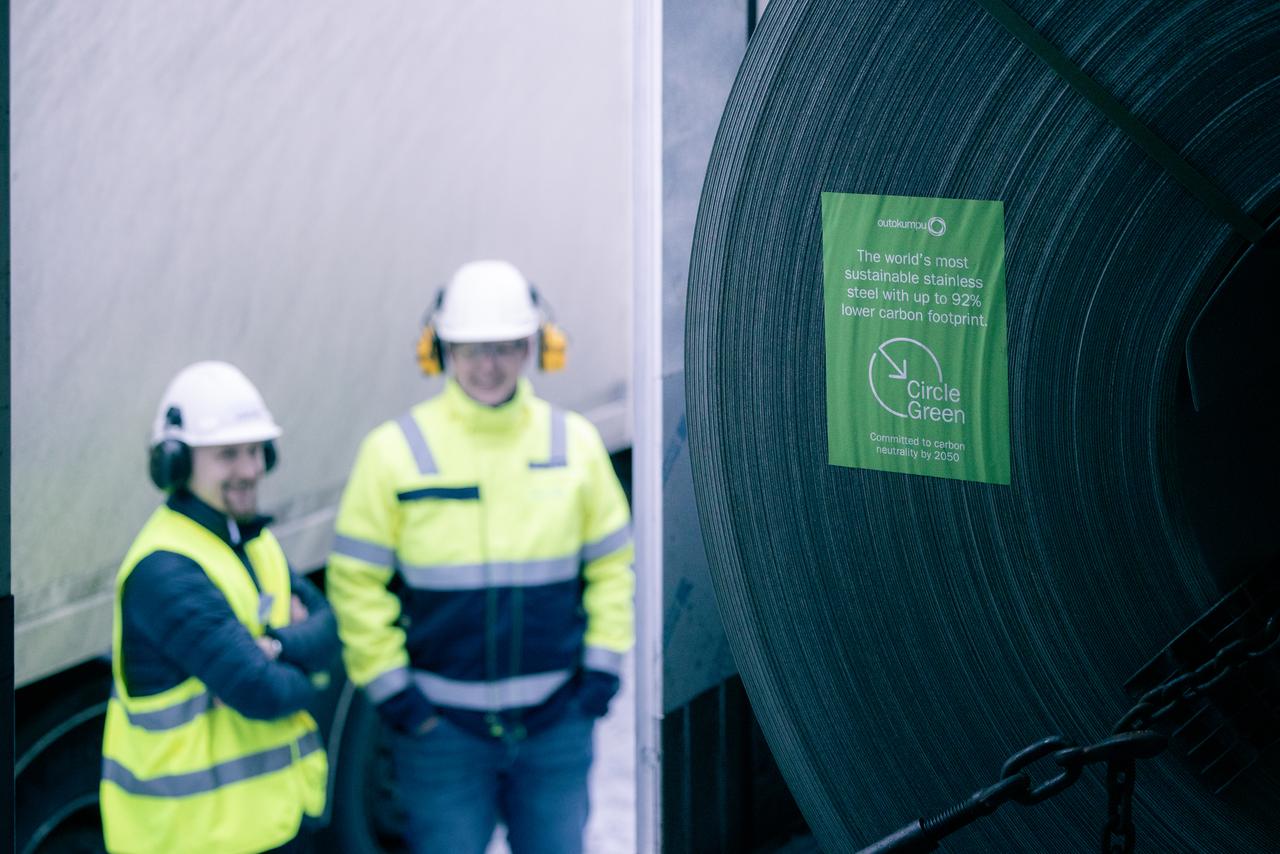
Outokumpu’s 2026 Circle Green information shows how supplier data is becoming more specific. The company reports a product carbon footprint across Scopes 1, 2 and 3 and publishes information for named grades including 304L/1.4307 and 316L/1.4404. Those values belong to the supplier’s products; they should not be copied into a generic specification for every stainless steel source.
In a coastal hotel, a pool hall or a sheltered facade near road salt, a lower-carbon grade that is unsuitable for the exposure can create cleaning, replacement or appearance problems later. The carbon comparison should follow the grade and surface decision, not replace it.
Material judgement
A carbon figure becomes useful when it remains attached to the material, finish, exposure and service condition that the project has actually approved.
05Finish and fabrication belong in the carbon record
Surface treatment is easy to leave out because it appears late in a material schedule. It can still change the environmental profile and the fabrication risk. Brushing, polishing, bead blasting, embossing, colouring and PVD are not interchangeable descriptions. A patterned or coloured surface can also change nesting, protection, inspection and replacement requirements.
Zahner’s sustainability page offers a concrete example: independently verified EPDs are published for selected Zahner surfaces, including Angel Hair Stainless Steel and GB-60 Stainless Steel. That is a product-specific example, not proof that every stainless steel finish on the market has equivalent documentation. When a finish matters to the project, ask whether the EPD covers the finished surface, the substrate only, or a defined product family.
Xinmao Metal’s product-facing judgement is straightforward: review a finish with the panel geometry and the intended touch, light and cleaning conditions. A sample proves appearance, but not the carbon boundary or long-term performance of the assembly. The schedule, finish approval and environmental document should refer to the same product.

06What architects and contractors should request
For projects sourcing from China, the China Metallurgical Industry Association’s January 2026 update on Baosteel’s EN 15804-compliant EPD for structural thick plate is a useful market signal. It concerns structural steel, not decorative panels, but shows why buyers are asking regional supply chains for comparable documentation.
07Turn the document into a buildable metal package
For Xinmao Metal, carbon data becomes useful when it moves from a sustainability target into a coordinated metal package. A facade, screen or interior cladding brief needs one consistent description across the schedule, approved finish, panel layout and purchase record. The source document should match what is shaped, finished, packed and installed.
When a project includes custom stainless steel decorative screen panels or custom stainless steel laser-cut decorative screens, the environmental question should sit beside pattern, edge, fixing and maintenance. The same logic applies to custom water-ripple stainless steel ceiling panels: a surface description must stay connected to the fabricated item.
This approach does not promise a low number before the product is known. It leaves a clearer audit trail: which document was used, which assumptions were added and whether the final purchase still matches the design decision.
08Conclusion
EPDs make architectural material discussions more accountable, but they do not make specification unnecessary. The responsible route is to read the boundary, match the document to the real product, keep exposure and finish decisions technically sound, and add the fabrication and assembly stages that the EPD does not cover.
09Technical references
- U.S. Green Building Council, “LEED v5,” accessed 18 August 2026.
- U.S. Green Building Council, “LEED v5 Building Design and Construction Addenda,” 20 February 2026.
- EPD International, “Construction products (EN 15804+A2), version 2.0.1,” accessed 18 August 2026.
- Outokumpu, “Circle Green in retrospect: innovating a low-carbon stainless steel process,” 2026.
- worldstainless, “Structural Stainless Steels,” 2 June 2026.
- Zahner, “Sustainable Metal Cladding Solutions,” accessed 18 August 2026.
- Metal Architecture, “LEED v5 and Embodied Carbon: What Metal Specs Must Address,” 4 February 2026.
- China Metallurgical Industry Association, “Baosteel publishes EN 15804 standard EPD for structural thick plate,” 20 January 2026.